


Consider a specific value for M (the number of fractions), for example
M=7. A population is generated by selecting an array of M-1 random
numbers between zero and one, drawn from a uniform distribution
(x , with i=1...6). This array is sorted and padded with a leading
zero and a trailing one, becoming of size M+1. , with i=1...6). This array is sorted and padded with a leading
zero and a trailing one, becoming of size M+1.

The difference between subsequent numbers in the array is a new array
of size M (f

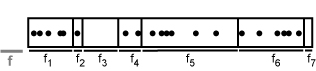
Random samples are generated by choosing k (for example 20) random
numbers between zero and one, also from a uniform distribution. On the
following figure, these numbers are marked by black dots. Each of the
relevant fractions ("boxes") of the population is tested to see if the
sample contains at least one number ("dot") that falls within it. On
the next figure, the relevant fraction size f is marked by a gray bar.
If at least one of the relevant fractions is empty, the test has
failed. This is the case for our example, since the third box is empty
and f
|
For each population, the ratio of the number of samples that failed the test to the total number of samples represents one estimate of p. This procedure is repeated for a large number of synthetically generated populations. The iterative process becomes of third order when a range of M values is evaluated (Figure 4).
 , with j=1...7), in which each element represents a
fraction of the total population. The population, when generated in
this way, is automatically normalized to one.
, with j=1...7), in which each element represents a
fraction of the total population. The population, when generated in
this way, is automatically normalized to one.
 f. Note that fraction #7 is also empty, but this is
irrelevant because f
f. Note that fraction #7 is also empty, but this is
irrelevant because f f.
f.