


 -emitting mineral
inclusions on closure temperatures
-emitting mineral
inclusions on closure temperatures
Besides complicating the -ejection correction, the
inhomogeneous U-Th-distribution inherent to inclusion-bearing apatites
also affects the diffusive behavior of the helium. This problem is
well studied in the case of concentrically zoned spherical crystals
(Meesters and Dunai, 2002b). The ``closure temperature'' (defined
below) of the (U-Th)/He system depends on the spatial distribution of
the helium. This does not constitute a significant problem for
relatively rapidly cooled rocks (e.g.  10
10  C/Ma for rocks older
than
C/Ma for rocks older
than  10 Ma). However, for slowly cooled rocks, the effect of
mineral inclusions on helium diffusion might induce significant
scatter in the apparent ages, depending on the spatial distribution of
the inclusions and their relative -emitting activity
(G-factor, equation 2), which are nearly impossible to
measure. To get a handle on the significance of this effect, this
section will consider the ``worst case scenario'' of a spherical
U-Th-free apatite containing an -emitting micro-inclusion at
its core or rim. Such a grain should have the most different
diffusive behavior compared to the default case of an inclusion-free
apatite containing a homogeneous U-Th-distribution.
10 Ma). However, for slowly cooled rocks, the effect of
mineral inclusions on helium diffusion might induce significant
scatter in the apparent ages, depending on the spatial distribution of
the inclusions and their relative -emitting activity
(G-factor, equation 2), which are nearly impossible to
measure. To get a handle on the significance of this effect, this
section will consider the ``worst case scenario'' of a spherical
U-Th-free apatite containing an -emitting micro-inclusion at
its core or rim. Such a grain should have the most different
diffusive behavior compared to the default case of an inclusion-free
apatite containing a homogeneous U-Th-distribution.
Before proceeding with the analysis, it is useful to recall the
definition of ``closure temperature'' by Dodson (1973). First
consider the case of isothermal diffusion for a simple geochronometer
defined by one radioactive parent P (e.g.,  K) decaying to a
radiogenic daughter D (e.g., Ar). At high temperatures, the
radiogenic daughter escapes from mineral grains as soon as it is
formed whereas at low temperatures, thermally activated diffusion is
negligible and the daughter products are quantitatively retained. Now
consider the case of monotonic cooling. In the high-temperature part
of the cooling-curve, the D/P-ratio stays zero. Under transitional
temperatures, the D/P-ratio increases at a rate that increases with
time. Finally, at low temperatures, D/P increases linearly with time.
The apparent age is the time intercept of the linear section of the
D/P vs time curve. This age corresponds to a particular temperature
in the cooling history, the so-called ``closure temperature'' T
K) decaying to a
radiogenic daughter D (e.g., Ar). At high temperatures, the
radiogenic daughter escapes from mineral grains as soon as it is
formed whereas at low temperatures, thermally activated diffusion is
negligible and the daughter products are quantitatively retained. Now
consider the case of monotonic cooling. In the high-temperature part
of the cooling-curve, the D/P-ratio stays zero. Under transitional
temperatures, the D/P-ratio increases at a rate that increases with
time. Finally, at low temperatures, D/P increases linearly with time.
The apparent age is the time intercept of the linear section of the
D/P vs time curve. This age corresponds to a particular temperature
in the cooling history, the so-called ``closure temperature'' T .
If the cooling curve is linear in the temperature T, then the closure
temperature (T) is the temperature intercept of the linear section
of the T vs D/P curve (Figure 6). If the cooling curve is
linear in 1/T, then T can be calculated analytically (Dodson,
1973). Things are a little more complicated for (U-Th)/He because
there are not one but three radioactive parents (
.
If the cooling curve is linear in the temperature T, then the closure
temperature (T) is the temperature intercept of the linear section
of the T vs D/P curve (Figure 6). If the cooling curve is
linear in 1/T, then T can be calculated analytically (Dodson,
1973). Things are a little more complicated for (U-Th)/He because
there are not one but three radioactive parents ( U,
U,  U,
and
U,
and  Th) with different half-lives, causing their relative
contributions to change with time. However, the helium content of
young rocks does increase linearly with time to a very good
approximation (t
Th) with different half-lives, causing their relative
contributions to change with time. However, the helium content of
young rocks does increase linearly with time to a very good
approximation (t  [He]/
[He]/ with as defined in
equation 3). Therefore, the closure temperature concept can
also be used for (U-Th)/He. Because we are interested in the
relationship between mineral inclusions and cooling rate (dT/dt), we
will assume linear cooling (dT/dt = constant with t). We will not
calculate T using Dodson's approximate analytical solution (an
exact solution is only possible if T
with as defined in
equation 3). Therefore, the closure temperature concept can
also be used for (U-Th)/He. Because we are interested in the
relationship between mineral inclusions and cooling rate (dT/dt), we
will assume linear cooling (dT/dt = constant with t). We will not
calculate T using Dodson's approximate analytical solution (an
exact solution is only possible if T  1/t). Instead, we will
calculate T numerically using the DECOMP program of Bikker,
Meesters and Dunai (Dunai, 2005).
1/t). Instead, we will
calculate T numerically using the DECOMP program of Bikker,
Meesters and Dunai (Dunai, 2005).
As said before, in the case of linear cooling T is the
temperature-intercept of a curve plotting temperature versus apparent
(U-Th)/He age (Figure 6). Thanks to a combination of the
``superposition principle'' (Meesters and Dunai, 2002a & b) and the
spherical symmetry, a concentrated -emitting inclusion is
mathematically equivalent to a thin spherical shell at the same
distance of the rim (A.G.C.A. Meesters, written communication, July
2006). A spherical shell of a certain U-Th concentration produces as
much He as a half-shell with twice, or a quarter-shell with four times
this U-Th concentration. By induction it follows that a U-Th rich
spherical shell is equivalent to a point source of equal
-emitting activity located at the same distance from the rim.
Therefore, individual inclusions can be adequately modeled as
spherical shells in DECOMP. The ``worst case scenario'' of a single
-emitting micro-inclusion located in the center of a U-Th-free
apatite was modeled in DECOMP by a spherical zone of 1  m radius
containing all the U and Th, contained in a much larger spherical host
apatite (e.g., R = 60 m in Figure 6), whereas an
inclusion located on the rim of such an apatite was modeled by a
spherical shell of 1 m thickness. Given a user-defined cooling
curve (10 C/Ma for Figure 6), DECOMP forward-models the
apparent age through time using an eigenmode-decomposition method
(Meesters and Dunai, 2002a & b). In this paper, we used 100
eigenmodes. The apparent age increases linearly with time in the
lower temperature part of the linear cooling model (Figure
6). As expected, the linear section of the T-t curve
begins at higher temperatures for the apatite containing an inclusion
at its core than for inclusion-free apatite. Intuitively, this makes
sense because the helium produced by the inclusion must ``travel
further'' before reaching the edge of the apatite. The opposite is
true for apatites with an inclusion on their rim.
m radius
containing all the U and Th, contained in a much larger spherical host
apatite (e.g., R = 60 m in Figure 6), whereas an
inclusion located on the rim of such an apatite was modeled by a
spherical shell of 1 m thickness. Given a user-defined cooling
curve (10 C/Ma for Figure 6), DECOMP forward-models the
apparent age through time using an eigenmode-decomposition method
(Meesters and Dunai, 2002a & b). In this paper, we used 100
eigenmodes. The apparent age increases linearly with time in the
lower temperature part of the linear cooling model (Figure
6). As expected, the linear section of the T-t curve
begins at higher temperatures for the apatite containing an inclusion
at its core than for inclusion-free apatite. Intuitively, this makes
sense because the helium produced by the inclusion must ``travel
further'' before reaching the edge of the apatite. The opposite is
true for apatites with an inclusion on their rim.
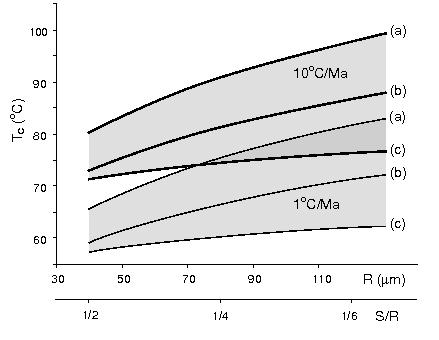
The closure temperature calculation was repeated for different
grain-sizes (40 m  R 130 m) and cooling rates
(10 C/Ma and 1 C/Ma) (Figure 7). In the ``worst
case scenario'' of an inclusion-bearing apatite, T is 5-10 C
higher or lower than in the absence of inclusions. This is a small
effect in several respects. First of all, the ``worst case scenario''
used for the calculations of Figure 7 is very unlikely to
ever occur in nature. As explained in Section 2,
mineral inclusions never contain 100% of -emitting activity,
because their relative volume is small and the U-Th content of apatite
is never zero. Consider the more realistic scenario of a mineral
inclusion contributing 50% of the total helium (G = 0.5). Because of
the superposition principle, such an inclusion will change the closure
temperature by only 2.5-5 C. The effects of grain size (15-20
C difference in T between 40 and 130 m, Figure
7) and cooling rate ( 15 C difference in T
between 1 and 10 K/Ma, Figure 7) are greater than the
inclusion-effect. Therefore, it should also be possible to apply the
HF-dissolution method to slowly cooled rocks. However, several
studies have reported irreproducible apatite (U-Th)/He ages for slowly
cooled terranes (Fitzgerald et al., 2006) and (U-Th)/He ages older
than apatite fission track ages (Soderlund et al., 2005; Green and
Duddy, 2006). Therefore, the next section will test the
HF-dissolution method on rapidly cooled rocks.
R 130 m) and cooling rates
(10 C/Ma and 1 C/Ma) (Figure 7). In the ``worst
case scenario'' of an inclusion-bearing apatite, T is 5-10 C
higher or lower than in the absence of inclusions. This is a small
effect in several respects. First of all, the ``worst case scenario''
used for the calculations of Figure 7 is very unlikely to
ever occur in nature. As explained in Section 2,
mineral inclusions never contain 100% of -emitting activity,
because their relative volume is small and the U-Th content of apatite
is never zero. Consider the more realistic scenario of a mineral
inclusion contributing 50% of the total helium (G = 0.5). Because of
the superposition principle, such an inclusion will change the closure
temperature by only 2.5-5 C. The effects of grain size (15-20
C difference in T between 40 and 130 m, Figure
7) and cooling rate ( 15 C difference in T
between 1 and 10 K/Ma, Figure 7) are greater than the
inclusion-effect. Therefore, it should also be possible to apply the
HF-dissolution method to slowly cooled rocks. However, several
studies have reported irreproducible apatite (U-Th)/He ages for slowly
cooled terranes (Fitzgerald et al., 2006) and (U-Th)/He ages older
than apatite fission track ages (Soderlund et al., 2005; Green and
Duddy, 2006). Therefore, the next section will test the
HF-dissolution method on rapidly cooled rocks.

|
|
<