


``Erroneous'' apatite (U-Th)/He ages have often been attributed to
U-Th rich mineral inclusions (e.g., Lippolt et al., 1994; House et
al., 1997; Fitzgerald et al., 2006). A very substantial part of many
(U-Th)/He studies is spent on selecting inclusion-free apatites under
the binocular microscope. Under reflected and transmitted light, with
or without polarizers, grains are scrutinized for imperfections and
mineral inclusions, in order to avoid the parentless helium problem.
But even when no inclusions can be detected with this method, it has
been suggested that sub-micron sized inclusions, only visible by
electron microscopy or fission-track mapping for uranium
inhomogeneity, might produce significant amounts of parentless He
(Farley and Stockli, 2002; Ehlers and Farley, 2003).
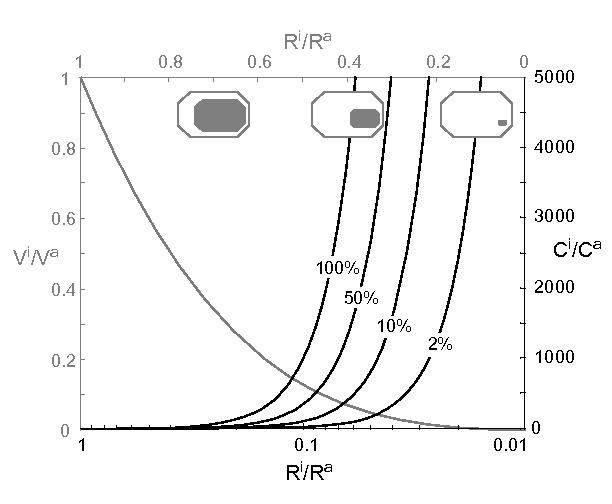
The validity of these concerns can be assessed by some simple
order-of-magnitude calculations. Consider a spherical apatite of
radius R containing a spherical mineral inclusion with radius
R
containing a spherical mineral inclusion with radius
R . If the inclusion is 10 times smaller than the apatite (R =
R/10), then its cross-sectional area is 100 times smaller
(A=A/100) and the volume of the inclusion is 1000 times
smaller than that of the host apatite (V=V/1000). In other
words, an apatite containing (an exceptionally low) 1 ppm U requires
such an inclusion to be 1000 times more concentrated in U (i.e. 1000
ppm) for it to produce an equal amount of He (Figure 1).
Identical arguments hold for non-spherical geometries. For example,
consider a prismatic apatite with 10 ppm of U, containing an inclusion
that is 1% of its length, 1% of its width and 1% of its height.
Such an inclusion has one millionth the volume of the host grain
(Figure 1). It would need to consist of pure uranium to
increase the helium by just 10%. Typical apatites used in
thermochronology have dimensions on the order of 100
. If the inclusion is 10 times smaller than the apatite (R =
R/10), then its cross-sectional area is 100 times smaller
(A=A/100) and the volume of the inclusion is 1000 times
smaller than that of the host apatite (V=V/1000). In other
words, an apatite containing (an exceptionally low) 1 ppm U requires
such an inclusion to be 1000 times more concentrated in U (i.e. 1000
ppm) for it to produce an equal amount of He (Figure 1).
Identical arguments hold for non-spherical geometries. For example,
consider a prismatic apatite with 10 ppm of U, containing an inclusion
that is 1% of its length, 1% of its width and 1% of its height.
Such an inclusion has one millionth the volume of the host grain
(Figure 1). It would need to consist of pure uranium to
increase the helium by just 10%. Typical apatites used in
thermochronology have dimensions on the order of 100  m, and U-Th
concentrations
m, and U-Th
concentrations  10 ppm (Farley, 2002). Zircon inclusions have U
and Th concentrations of typically 100-1000 ppm and sometimes up to
5000 ppm, whereas monazite can contain up to 30% of Th (Deer et al.,
1992). Therefore, sub-micron sized inclusions may be a less
significant source of parentless helium than previously thought,
unless they are extremely numerous and their composite volume is more
than a ten-thousandth or so of the host apatite. We will now shift
our attention away from micro-inclusions and focus on somewhat larger
inclusions which do contribute substantial amounts of parentless
helium.
10 ppm (Farley, 2002). Zircon inclusions have U
and Th concentrations of typically 100-1000 ppm and sometimes up to
5000 ppm, whereas monazite can contain up to 30% of Th (Deer et al.,
1992). Therefore, sub-micron sized inclusions may be a less
significant source of parentless helium than previously thought,
unless they are extremely numerous and their composite volume is more
than a ten-thousandth or so of the host apatite. We will now shift
our attention away from micro-inclusions and focus on somewhat larger
inclusions which do contribute substantial amounts of parentless
helium.
|
 He-production. The
black lines show the U or Th concentrations C
He-production. The
black lines show the U or Th concentrations C